7 Reasons You Eat Well and Still Feel Flat by 3pm
The first one started long before you bought the carrot. Three of them you can check tonight, in your own kitchen.
You are doing it right.
Vegetables at dinner. Fruit in the bowl. Real food, cooked at home, most nights of the week. Then somewhere around three in the afternoon the lights go down a little, and a second coffee starts to sound reasonable.
That is not a discipline question.
Start with the three o'clock part, because that is why you are here. An afternoon dip has more than one cause, and no honest page will hand you a single one. Food is the cause with numbers attached to it, so food is the one this page stays on. It is also the only one you can read off a label and add up.
Seven things sit between the field and your fork. Each one takes a small share of what was in the vegetable, so what lands on your plate is less than the nutrition chart says. Here they are. Three of them come with something you can check tonight.
The same carrot, fifty years apart
In 2004 three researchers put the USDA nutrient tables for 43 garden crops side by side, 1950 against 1999. Six nutrients had dropped over those fifty years, among them calcium, iron, riboflavin and vitamin C.
They put it down to breeding rather than to tired soil. Crops bred for size and yield grow bigger and faster. The same minerals then sit spread through more vegetable.
The authors were careful about it. Lab methods changed a great deal in fifty years, so some of the gap is measurement rather than farming. Their own reading was that a real drop sits underneath the noise.
Same carrot, same weight, fewer minerals in it than the chart your parents grew up with.
Heat takes a share back
The USDA keeps a table almost nobody outside food science reads, the Table of Nutrient Retention Factors. It lists, food by food and method by method, how much of each nutrient survives the pan.
The pattern is easy to hold. Minerals stay put, and so do most of the fat-soluble vitamins. Vitamin C and the folate family move into the water, and when you pour the pot out, they go with it.
Boiling costs the most. Steaming and roasting both keep more of it.
Try this tonight. Keep half a cup of the broccoli water and pour it into whatever sauce you are already making.
Fiber is where the real gap sits
In 2017 the American Journal of Lifestyle Medicine ran a paper with the gap in its title, Closing America's Fiber Intake Gap. Average adult intake sat at around 16 grams a day. The adequate intake is 25 grams for women and 38 grams for men, and roughly 5 percent of Americans get there.
The same year, the CDC reported that 9.3 percent of US adults met the vegetable recommendation and 12.2 percent met the fruit one. The bar is higher than most people picture it.
Fiber is also not one thing. The soluble kind feeds the bacteria in your large intestine. Those bacteria make short-chain fatty acids, and the cells lining your colon burn them as fuel. That is a supply line, and it runs on what you ate today.
Add up one ordinary day on a label app. You will have a real number instead of a guess, and for most people that number lands at about half the 25 to 38 grams.
Timing changes how much you keep
In 2005 the Journal of Nutrition published a feeding study on salad and salsa. When avocado went in, absorption of alpha-carotene, beta-carotene and lutein rose sharply in the people tested.
The reason is plumbing. Those pigments are fat-soluble, so they need fat in the same meal to cross the gut wall. Without it, a share of them travels the whole way through and leaves again.
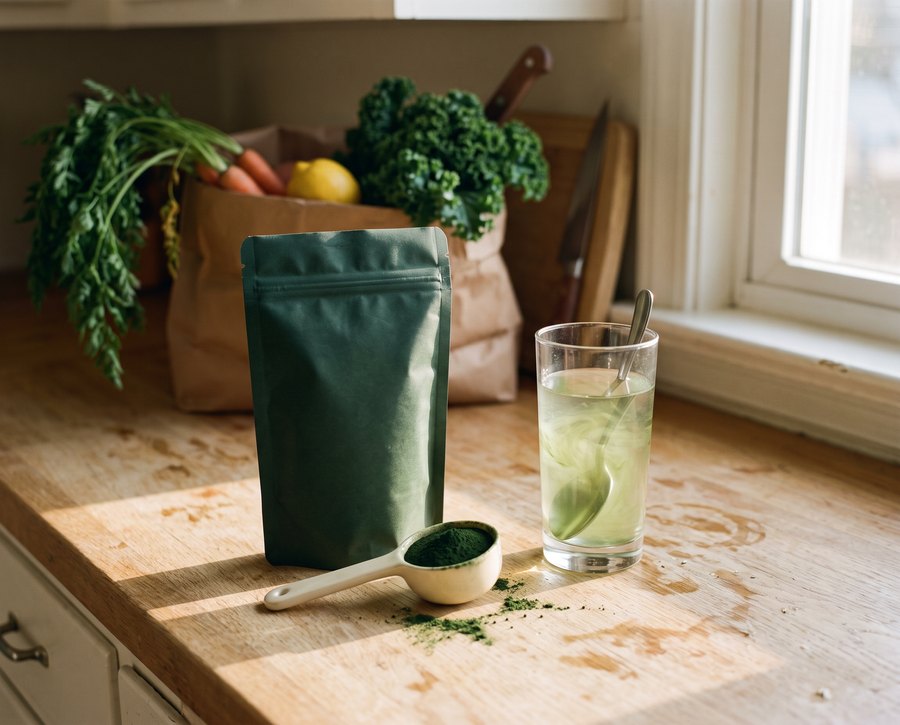
Which makes a scoop of anything green, stirred into water on an empty stomach, an odd choice. Ninefold Greens prints the instruction on the front of the pouch for that reason. Take it with a meal, not before one.
See what one scoop actually holds, before you decide anything.
Read the full labelNine ingredients, each with its own amount. Nothing to fill in.
The form matters more than the milligrams
Magnesium is the clean example. In 2003 the journal Magnesium Research published a randomized trial comparing three magnesium supplements. Magnesium citrate came out more available to the body than magnesium oxide did.
Oxide is the cheap form. It sits on a lot of labels because it packs a big milligram number into a small space. The figure on the front is accurate, and your body still ends up with less of it than the same figure in citrate form.
Turn your own bottle over tonight and read the word after the mineral. That word is doing more work than the figure beside it.
Ninefold uses citrate and glycinate forms. The form is printed next to every mineral, which is one reason the label runs long.
The amounts are small on purpose. One scoop carries 48 milligrams of magnesium and 6 milligrams of zinc, which is a top-up rather than a day's worth. Both numbers are printed so you can add them to whatever else you already take.
A blend can hide the dose
The FDA's supplement labeling rule is 21 CFR 101.36. It lets a maker list a group of ingredients as a proprietary blend, with one total weight and no breakdown. Twelve ingredients, one number, 2,400 milligrams.
That is legal, and there are formulas genuinely worth protecting. It also means the first ingredient can be 2,300 of those milligrams and the other eleven can be a pinch each.
From the outside you cannot tell which one you bought. What you can tell is whether the maker chose to show you.
| What to read | Why it tells you something | Ninefold Greens |
|---|---|---|
| Each ingredient with its own amount | A blend total hides which ingredient you are mostly paying for | 9 named, 9 amounts |
| The form printed beside each mineral | Citrate, glycinate and oxide are taken up differently | Citrate, glycinate |
| Fiber grams in one serving | Against 25 to 38 grams a day, under 1 gram is a rounding error | 5 g |
| Where the sweetness comes from | Fruit powder is there for sweetness, so it takes up scoop space the greens could have had | No fruit powder |
| The weight of one scoop | A scoop holds no more than it weighs, so a 3 gram scoop cannot carry 5 grams of fiber | 12 g scoop |
| A batch code you can call about | A code and a phone number mean somebody keeps records | On the pouch seam, and the number to call is printed below |
The seventh thing is the swap itself
This is the item a greens company would rather leave out.
No powder is food. There is no chewing in it, no bulk, no water, and none of the hundreds of plant compounds nobody has measured yet. A scoop cannot do what a plate does.
A scoop does one narrow job. It carries a known amount of a small number of things, every day, at the same time, without a pan. That is the whole of it. It is worth doing when the other six reasons on this page are all running at once.
And about three in the afternoon. Nobody can promise you a different one, and this page will not try. What a scoop does is close the part of the gap that carries a number. Whether that shows up in your own week is a thing only your own week can answer.
Ninefold Greens is built for that job and nothing wider. Nine ingredients, each printed with its own amount, and 5 grams of fiber in the scoop. On the back of the pouch there is a line telling you to eat your vegetables.
What the $59 buys
Read the label and the first objection arrives on its own. Half the scoop is psyllium husk and oat fiber, and those two are the cheapest things in the pouch. Any pharmacy sells them on their own. If plain fiber is all you are after, buy the plain stuff and keep your money.
Here is the other half of the scoop. Five plant powders with their own amounts, magnesium as citrate, zinc as glycinate, nine numbers on the label instead of one blend total, and a batch code that matches a record somebody keeps. One pouch is thirty days of that.
The 5 grams of fiber is a piece of the 25 to 38 gram day, not the whole of it. And the scoop is one thing on the counter instead of a row of tubs. That is the trade. It is printed in full, so you can price it yourself before you spend anything.
What it costs
- One pouch is 30 servings, at 12 grams a scoop.
- $59 a month on the monthly plan, or $69 for a single pouch.
- Shipping is free in the US on the monthly plan.
- 90 days to change your mind. The pouch can come back empty and the money still goes back.
- Pause or cancel from the account page. No call, no email.
★★★★★ 4.8 out of 5, from 1,900+ reviews
$59 a month, 30 scoops in the pouch, shipping included
Start the monthly planOne pouch is thirty days. The window to change your mind runs three times that.
There is no deadline on this and no reason to invent one. A pouch is thirty days. The honest way to judge it is to run two of them and look at your own afternoons. The 90 days is set to leave you a full month after that to change your mind.
90 days to send it back, empty pouches included
Nine ingredients, nine printed amounts, no blend total
Batch code on every pouch seam
What people write in
I put it beside the tub I was already using and this is the one still in the cupboard.
Renee C. · Subscriber, 16 monthsNot a treat. Ten seconds, glass rinsed, on with the morning.
Gordon L. · Subscriber, 8 monthsThirty scoops and the last one still came out level. The pouch does what it says.
Tessa W. · Subscriber, 5 monthsSix weeks in. I cannot prove a thing, but the second coffee has not come back.
Dale W. · Subscriber, 3 monthsTake 90 days to find out whether it fits your week.
Get Ninefold Greens at $59 a month$59 a month with the shipping in it. A 90 day money back window, empty pouch and all.