Why Is Your Size Different in Every Brand?
Nobody has to agree on what a 32 means. Three numbers you take at home predict fit better than the label on the tag.
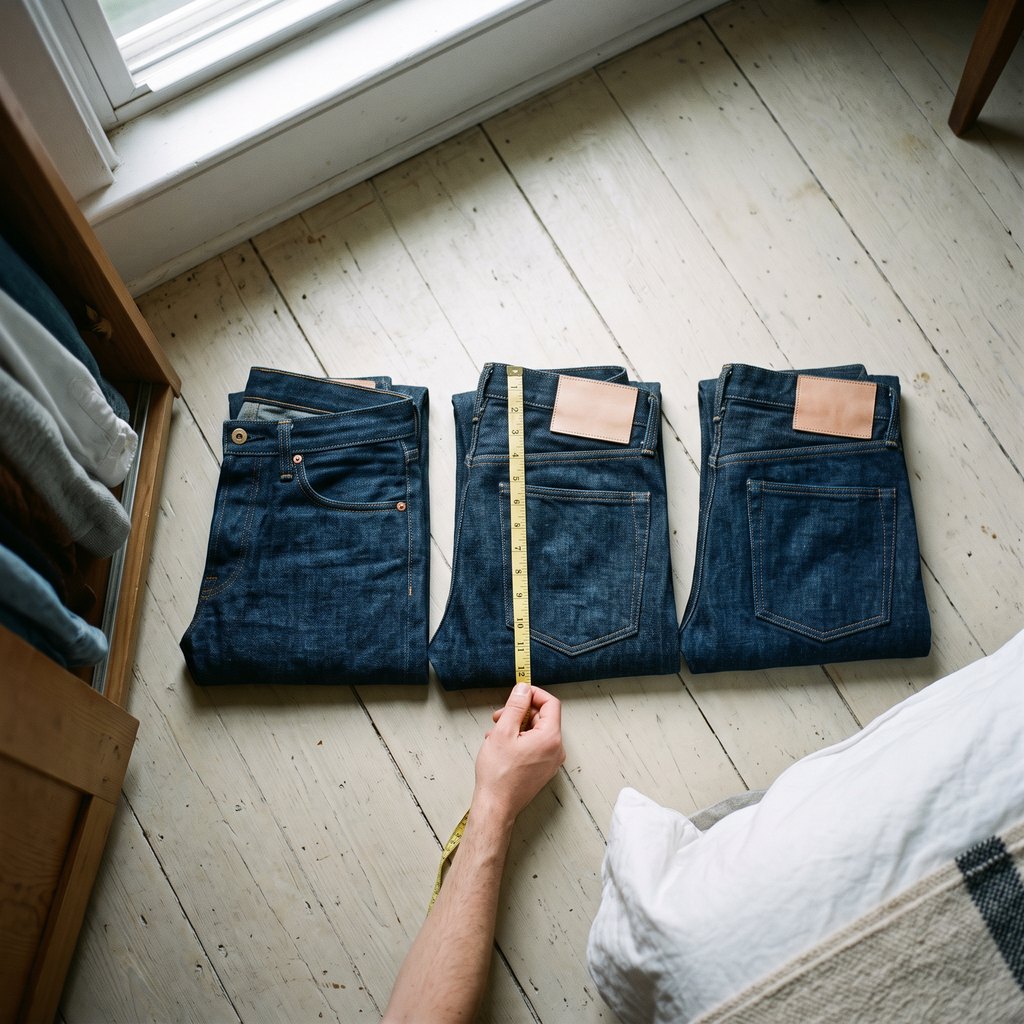
I measured the pair I already liked, wrote three numbers down, and ordered the right size the first time.Jordan P.
Your size is not one number.
Pull five pairs of jeans out of your closet and lay the waistbands flat. Run a tape across each one. On the same printed size, the tape will not agree with itself.
That is not carelessness at the factory, and it is not your body changing between stores. Here is why it happens, and the three numbers that settle it.
01. What a 32 used to mean
There was a national standard once. In 1941 the US Department of Agriculture published a study of 14,698 women measured head to toe. In 1958 the Department of Commerce turned that work into Commercial Standard CS 215-58. Following it was always a choice, so some brands cut to that one table and some cut to their own.
A new version replaced it in 1970, and that one was withdrawn in 1983. Since then there has been no government table at all. ASTM International publishes sizing tables today and every one of them is voluntary. A brand can follow those tables or set its own.
What happens instead is simple. A brand picks a fit model and cuts to her body. It then makes that same pattern bigger and smaller for every other size, which the trade calls grading, and prints whatever number it likes on the tag. Two brands can both be honest and still put a 32 on waistbands an inch and a half apart. Every sizing table in a store today is a house rule.
02. The number nobody measures
Waist and hip are the two figures most people know. The one that decides how a pair feels at four in the afternoon is the front rise. That is the distance from the crotch seam straight up to the top of the waistband.
Rise works by moving where the waistband sits on you. Add an inch of rise and the band climbs off the top of your hip. It lands on your natural waist, which is a narrower part of your body.
Take an inch away and the band drops onto the hip, which is wider. The tag still says 32. Your body is now being measured somewhere else.
So a pair that fits in the changing room can slide down by lunchtime. The waist number was right for that waistband. The rise put the waistband somewhere it could not stay.
I had two pairs the same size and only one of them stayed up. The rise was the whole difference.Marcus T., Verified Customer
03. Three numbers, four minutes
Take these with a soft tape, over a t-shirt, standing normally.
- Waist. Around your body at the exact height you like a waistband to sit. Not at your belly button by default, and not pulled tight.
- Hip. Around the fullest part, feet together, tape level all the way round.
- Front rise. Take a pair you already like. Lay it flat, button it, and measure from the crotch seam straight up to the top edge of the waistband.
Write all three in your phone, in inches. Any brand that publishes the measurements of the finished garment can be checked against your own numbers. A brand that only publishes a body-size chart cannot. That check takes under a minute, and it happens before anything ships.
Four minutes with a tape on a Sunday, and the pair that turned up fit straight out of the bag.Elena V., Verified Customer
04. What each number decides
| Waist | |
|---|---|
| What it decides | Whether the button closes without pressure at the front |
| How to take it | Around the body at the height you wear a band |
| Why brands differ | Some brands lay the finished pair flat and double the waistband. Others print a body measurement |
| Hip | |
| What it decides | Whether the pair pulls across the seat when you sit down |
| How to take it | Fullest part, feet together, tape level |
| Why brands differ | Every brand adds a different amount of hip room from one size to the next |
| Front rise | |
| What it decides | Where the waistband sits, and whether it stays there |
| How to take it | Crotch seam straight up to the top edge, laid flat |
| Why brands differ | Rise is a style decision, so it moves season to season |
| Thigh | |
| What it decides | How close the leg sits from the crotch down to the knee |
| How to take it | Across the leg one inch below the crotch seam, then doubled, because the tape only crosses half the leg |
| Why brands differ | Stretch content changes how much room a cut needs |
| Inseam | |
| What it decides | Where the hem lands on your shoe |
| How to take it | Crotch seam to hem along the inside leg |
| Why brands differ | Brands cut for different average heights in their market |
Waist and hip pick the size. Rise picks where the band sits.
I read the hip column now instead of the waist. That is the one deciding the seat.Tomas B., Verified Customer
05. Why a pair goes back
Returns are not a rounding error on a retailer's sheet. The National Retail Federation and Appriss Retail put returned merchandise at 743 billion dollars in 2023. That was 14.5 percent of everything sold in US retail that year, and 17.6 percent of everything sold online.
That report does not split the pile up by product, so nobody can say from it how much of that money is clothing. What sends a pair of jeans back is mechanical rather than mysterious. A shopper who cannot check a garment against their own numbers orders two sizes on purpose and sends one back. The tape at home removes the reason for the second box.
I used to order two sizes of everything. Now one box turns up and it stays.Grace W., Verified Customer
06. What to look for on a product page
Tanbrook Denim publishes the full garment measurements on every pair, including the front rise in inches. One rise ladder runs across all three of its fits. Low sits at 8.5 inches, mid at 10.5 inches, high at 12 inches. Every size in a fit carries the same rise.
That is the part worth copying whoever you buy from. Match the rise to where you actually wear a waistband first. Once the band sits in the right place, the waist number becomes a detail rather than a gamble.
You can check the next pair you order before it ships.
The rise is printed on the tag, so I knew where the band would sit before the box arrived.Maren K., Verified Customer
The indigo fades down the seams
The rope dye came out darker than the photo and six months in it has faded along the seams rather than all over.Daniel R. · Verified Buyer
Same band after the first wash
Cold wash, hung to dry. The band came back a little tighter and an hour of wearing put it straight back where it was.Claire D. · Verified Buyer
Three days, label in the box
Ordered on a Tuesday and they were here Friday, with a return label already in the box that I did not end up needing.Owen M. · Verified Buyer
Stiff for the first week
The size was right off the table. The 14 oz is stiffer than anything I own and it took a week of wearing before it moved with me.Hannah L. · Verified Buyer
Find your fit, your rise and your size from your own numbers
Two steps, both of them numbers you read off a tape.
Tanbrook fit match
Type the three numbers you measured
Waist, hip and the front rise of a pair you already like, in inches. One more question after those asks the inside leg you take, so the length comes back right as well.
Free shipping both ways. Sixty days on the fit.