How to Take the Chlorine Out of Your Shower Without Touching the Plumbing
Five steps. The first two are free and take ten minutes.
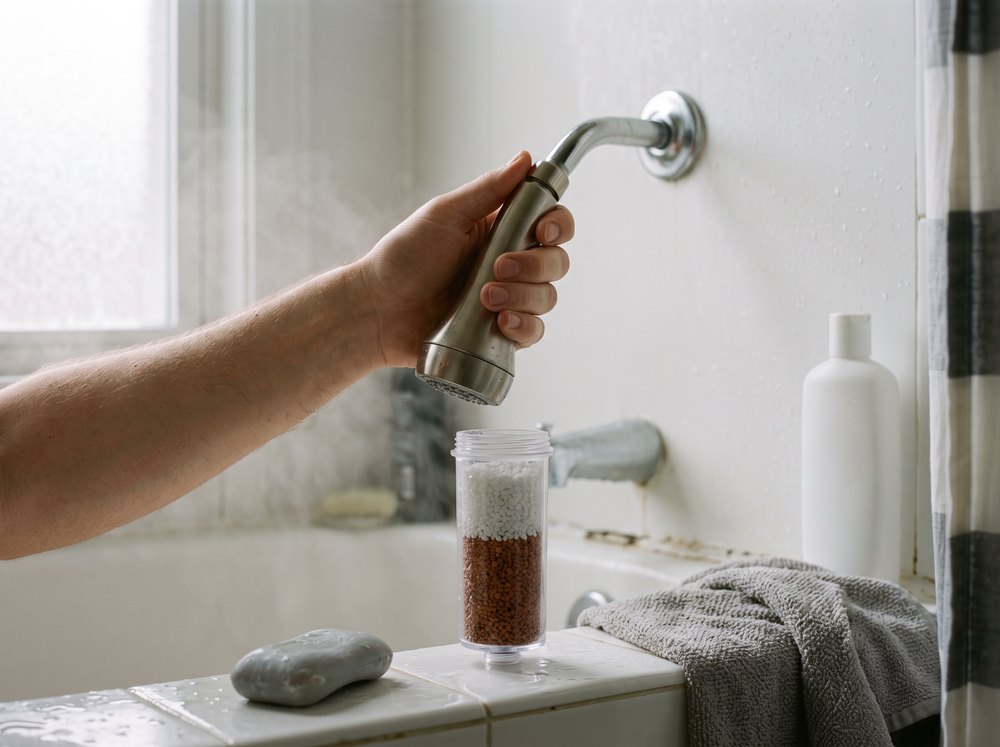
Start with the water.
Two different things come out of a shower head and people mix them up. Hardness is calcium and magnesium. It is what leaves the white film on the screen, and no shower head moves it.
Chlorine is the other one. Your utility puts it in to keep the water clean on the way to your house. It is still in there when it reaches you. That is the part a filtered head takes out, and that is what the five steps below are about.
The first two steps are free. They tell you what is in your own water before you spend anything.
1. Smell your own shower water
Chlorine is a dissolved gas. Leave a glass of tap water on the counter overnight and most of the chlorine has gone by morning. Heat and a fine spray do the same job much faster, which is why the smell is strongest in a hot shower.
So run yours hot for a minute with the door shut. That sharp clean smell in the steam is chlorine leaving the water. It costs nothing, and it tells you there is something in your water for a filter to work on.
2. Look up which one your utility uses
Chlorine and chloramine are not the same thing. Chloramine is chlorine bonded to ammonia, chosen because it stays in the pipes for longer, and it stays in the water too.
The EPA caps either one at 4.0 milligrams per liter in drinking water. Your utility names which of the two it uses in its annual water quality report. Search your town name plus water quality report and it is usually the first result.
Free chlorine is the one a shower filter is built for, and the good ones are good at it. If your report names chloramine instead, read the last section of this page before you order anything.
What changes when the chlorine goes
Two things change, and one of them is far surer than the other.
The smell is the sure one. Free chlorine is what you are smelling in hot steam, so when the free chlorine goes the smell goes with it. You know what your shower smells like today, because step one had you stand in it. You get that answer back on the first hot shower.
How your skin and hair feel is the slower one, and there is no number behind it. Clearfall has no study on skin and does not print one. What we can do is tell you where to look. It is your face in the ten minutes after a hot shower, and it is the way your hair feels once it has dried on its own.
So the sixty days have a job. Shower the way you always do, then answer three questions. Is the sharp smell gone from the steam? Does your skin feel easier when you step out? Does your hair dry softer than it does today? A week settles the first one. Sixty days is long enough to call the other two.
See what is actually inside a cartridge.
Read the Clearfall media list →Gram weights for both media, the chlorine figure and the test behind it. No email asked for.
3. Read the media, not the marketing
Two things do most of the work inside a shower filter.
KDF-55 is copper and zinc alloy in granules. Free chlorine passing over it picks up an electron from the zinc and turns into chloride, the same chloride that is in table salt. It keeps working in hot water, and hot water is what a shower filter lives in.
Calcium sulfite reaches the same end by a different route. Filters worth the money usually carry both, because each one covers the other's weak spot.
Then there is everything else on the shelf. Colored beads, mineral stones and vitamin C blocks all turn up inside shower heads.
Vitamin C does neutralize chlorine. Utilities use it on mains water before discharge, so the chemistry is real. Inside a shower head it dissolves while it works, which makes it a consumable measured in weeks.
So here is the check that costs nothing. Turn the box over and look for the two media by name, with a gram weight next to each. A head that prints neither is asking you to take its word for it.
Clearfall runs KDF-55 and calcium sulfite in one cartridge and prints the gram weight of each on the box. You can make that comparison before you buy.
4. Ask what the cartridge costs
This is the part people skip. Media get used up. A shower filter that never asks for a new cartridge is a shower head.
Clearfall's cartridge runs six months and costs $24. The date is printed on the cartridge face, so you are not counting months in your head.
So the first year is $118 for the head with its first cartridge already in it, plus one $24 swap at six months. That is $142, and nothing else.
5. If you rent, check the arm first
Nearly every shower head in the United States screws onto a half inch pipe thread. It comes off by hand or with a strap wrench, the old head goes in a drawer, and it goes back on the day you move out. Nothing is drilled and nothing is cut.
Two things to look at before you order. The first is the arm.
A fixed arm coming out of the wall takes any standard head. A rail system, where the head slides up and down a bar, usually will not. Neither will an all-in-one unit with the controls and the head in one panel on the wall. Two minutes with a flashlight settles which one you have.
Flow is the second one. Federal law caps a shower head at 2.5 gallons a minute, and a filter cannot lift that. A filtered head that feels weak is usually the flow restrictor doing its job rather than the media blocking up.
Clearfall against those five steps
Both media are in there to take out the free chlorine you can smell in the steam. Clearfall takes out 96 percent of it, and holds that figure across the full 8,000 gallons the cartridge is rated for.
That number is Clearfall's own bench test, run at 105 degrees Fahrenheit and 2.5 gallons a minute on the same cartridge that ships in the box. No outside lab has certified it and there is no badge on the box. It is printed there with the gram weights beside it, so the check in step three is one you can run on this product.
The cartridge runs six months, carries its own printed date, and costs a fixed $24. The thread is the standard half inch. It goes onto a wall arm by hand and comes off the same way.
What Clearfall does not do
Two limits, both worth knowing before you spend.
It leaves your hardness number exactly where it was. Softening means pulling calcium and magnesium out of the water, and that is an ion exchange job. It needs a resin tank and a bag of salt, and it happens where the water comes into the house. No shower head does it, whatever the box says.
Your hardness figure sits in the same report as the disinfectant. The USGS scale runs soft below 60, moderately hard up to 120, hard up to 180, and very hard above that. Clearfall moves none of it.
Chloramine is the second one. It needs far more contact time than a small canister on a shower arm can give it. If your report names chloramine rather than chlorine, this is not the right buy for you. Step two is where you find that out.
Shower with it for sixty days, then answer the three questions.
Get Clearfall at $118 →Free US shipping. If your three answers read the same as they do today, send it back inside sixty days for a refund. Cartridge $24 every six months, and the date is printed on it.